19 November 2022

Looking Back

They say that if you don't look back at who who were from a year ago and cringe that you haven't grown enough.

What if I look back five or seven years?

It's funny to see that some ideas are still rattling around in my head. And it's funny to see what has changed. I've gotten more into Zen and less into roleplaying games, for example. More into Tiktok and less into blogging. I've come to terms with 4e and GURPS, but mostly because nobody plays either of them anymore.

I've published (and sold!) games on itch- something I never would have dared to do in my 20s. There's a whole scene now, on the possibly soon to be doomed Twitter that makes just exactly the kind of games I used to love playing...

This thought inspired by finding a blogspot app still installed on my phone. Hello out there, old friends and followers! How have these long years treated you? Do you have kids now? Own a house? What do you think about all this? <gestures wildly>

08 November 2019

D&D is a game about resources

Sometimes it pretends to be a game about stories, or adventures, but it isn’t. It’s a game about what you have- hit points, weapons, armor, spells, gold, and experience points. (It’s also about how good you are at getting those things.)

It mostly trades in two currencies- hit points, and spell points. (spell slots, metamagic points, whatever). There are others, but these are the most important. D&D asks you to risk those currencies in a dice game, with the stakes set in the fiction, modified by however good your character is at whatever you’re doing.

The rewards are always things you can write on your character sheet- experience points, gold, items. You don’t have to track anything else.

You can trade experience points for additional power and utility, allowing you to earn more experience points, which you always want.

You can trade gold for additional power and utility, but only to a point. It’s usually easy to buy all of the best items in the game, with additional gold being useless. The game doesn’t model economics, or any mercantile activity, or construction.

And that’s it. 95% of the game is either about getting resources or spending resources ( to try to get more resources). Everything else is window dressing or freeform roleplaying.

(From my other blog)

07 July 2019

Can't Stop Thinking About Weapons

Predictably enough, when I set down to whittle the 5e rules down to something that I'm interested in running, one of the first things that I take a look at are the rules for weapons.

Have I actually laid out what my issues with the weapons list in 5e is? It's both boring and long, with obvious traps in damage and functionality, and somehow also lacking in anything resembling interest. If you want to do a big long list of weaponry, you can do better by looking at one of the Warhammer 40k weapon lists, with all of its modifiers and finnicky bonii, or you can look directly at FantasyCraft, which takes great pains to make each weapon type distinct through the liberal use of feats and class features.

5e doesn't do either, which is why I always want to get rid of it. 5e isn't really a game about whether you should bring a sword or an axe or a spear, and I kind of want it to be.


 So here's a little something inspired by much-maligned weapon speed rules in 1E.


03 February 2019

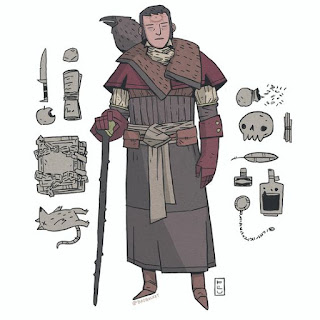
Gervan, Sorcerer

https://www.pinterest.com/pin/833940055972909486/


Gervan

Level 3 Sorcerer

Hit Points: 9
Willpower: 5
AC: 15
Attack: 1


Flaw:
    Seeks power at all costs

Characteristics:
    Wise-
    Swift-
    Willful-
   
Feats:
    Literate- Gervan can both read and write.
    Familiar- Kronk the raven. Kronk can speak common and knows Shadow Lore. Can fly. Loyal to Gervan, they are magically bonded and always know where the other one is.
   
    Sorcery- 6 Sorcery Points. Gervan can spend Sorcery points to cast spells.
        Study- Must Study during Rest Phase to recover Sorcery points.
        Rituals- Can use Ritual magic during the Rest Phase.
        Witchsight- Can detect magic at will. Magic has a distinct shimmering color, indescribable to non-sorcerers.
   
    Red Lore II- Gervan knows Red Lore, and can cast the following spells:
        Power Bolt- 1+.  Can throw a bolt of glowing mystical energy at enemies. Ranged attack. Deals 1d8 per Sorcery Point spent.
        Catsight- 0. At will, can gain Darkvision and Light Sensitivity.
        Barrier- 1+. A field of glowing force surrounds Gervan or a touched ally. It can absorb 1d4 points of damage per Sorcery Point spent before it dissipates.
           
    Necromancy I-
        Speak with the Dead- Ritual. Can speak to the recently deceased, asking them one question per Sorcery point spent before the magic fades. The dead are under no compulsion to speak the truth.
        Hide from Undead: 0. For one minute, Gervan cannot be seen or smelled or otherwise detected by the undead. Effect ends if Gervan makes an attack.
       
Items:
    Grandfather's Skull- Gervan's grandfather taught Gervan magic from beyond the grave. When he died, his skull was attuned to his bloodline through a dark ritual and so the skull itself talks to Gervan in a hollow, reedy voice. It was louder when he was younger. These days, the skull is very quiet, and Gervan must meditate to get any information whatsoever out of it. Gervan doesn't quite know why.
    Dead Rat- Gervan's discarded this rat multiple times, but it always ends up in his backpack or under his feet, or wherever, just as soon as he thought he'd gotten rid of it. Gervan assumes it's part of some curse he's accumulated, or something.
    Bound Grimoire- This book wants to be opened and read. Unfortunately, it's full of vulgar nonsense.
    Ritual Knife- Doubles as a weapon in a pinch. 1d4 damage, melee. Light. Throwable.
    The Duke's Permission- Gervan is a licensed sorcerer, with permission to practice from the Duke.
    Quill and Ink- Kronk is a good messenger and will carry small belongings to and from Gervan's contacts.
    Bag of Bone Dust- An important ingredient in Necromancy rituals.

28 January 2019

willpower, sins, and flaws


one of the things I liked best about when I was playing the world of darkness games was the way that willpower worked. the basic idea was that your character had a virtue and a vice (based off the seven deadly sins, naturally), and if you wanted to resist your sin you had to spend willpower, usually, and if you acted according to your 'better nature' you'd get some willpower back. you also got willpower back for indulging in your sin, I believe. interestingly, you could also spend willpower to get like, better dice rolls.


ok so, world of darkness games. vampire, werewolf, ghosts, mages, they all have willpower. a character's player can choose to spend willpower to get a boost on dice rolls, or fuel magic, or whatever.

also on a character's sheet are one of the seven deadly sins- sloth, lust, greed, whatever. the character can gain willpower for leaning into their sin, for playing into their darker nature, for showing weakness. the character also has to either spend willpower or take a chance of slipping into bad habits when the target of their weakness comes up. the lustful vampire has a hard time not spending the arms in his or her lover, even when they really should be safe in their stronghold hiding from their hunters... the envious mage has a hard time resisting the opportunity to show off even when they really shouldn't, and etc.

this does a couple of things- it hooks the character and the player together in a really strong way, by making the player care about what the character cares about. if you take care of your in-game avatar, that avatar is more competent, more resilient, and more able to effectively carry out the player's interests in the game. and it also points the GM towards a conflict that the player probably finds interesting, or at least a conflict that the player has already greenlit. a lot of players don't care to have their characters' father or sister as hostages or whatever, but they've definitely given the GM permission to tempt their character with lots of gold, or give them opportunities to showboat and brag, right? and it also lets the player look for these opportunities to let the somewhat more negative side of their character show through if they've had a rough couple of episodes. and that's interesting! there are always lots of opportunities for player characters to be noble and competent, for them to be clean and respectable. [1]

now that I think about it, though, the world of darkness games are necessarily rooted in a very specific sort of western ethos, that subconsciously christian worldview where pleasures are to be enjoyed in moderation, where you are supposed to congratulate yourself for, essentially, being sober and productive at work and whatever else. that doesn't really apply to the sorts of fantasy worlds I want to emulate. I mean, you can do whatever you want in your world- you can just decide that the seven deadly sins are perfectly acceptable to you. but I don't know- a dwarf is not going to understand that she should limit her gold hoard's size, and elves are notoriously indifferent to the human concept of 'vanity,' let alone pride. halflings don't hold with all that running about nonsense and if you call them 'slothful' you're really missing out on a good understanding of their culture and personality.

but here's kind of more of what I was thinking- make it more personal. I'd have my players consider and detail a particular failing of their character, something that they really struggle with. and they can just be the sins, too! something along the lines of 'my barbarian has a weakness for violence, the more indiscriminate the better,' or maybe a more subtle issue, something like 'my cleric looks down upon those without divine powers and has to remind herself not to treat other as beneath her just because they haven't been chosen by the gods.'

personally, I'd take this opportunity to do some world-building too, and give examples of a couple of cultural folk heroes, demigods, and local celebrities, as well as what makes them such exceptional people. maybe a given dwarf king is legendary due to his wisdom, dispensal of justice, and (naturally) his unbeatable wealth, whereas a dwarf wretch is irrational and poverty-stricken and physically weak, unable to defend his stronghold and despised by his family. maybe this particular band of humans idolizes a cleric-beggar-wanderer who used her powers to tend to the sick and downtrodden and gave the ultimate sacrifice and died to save the world from a very particular evil. and then maybe those same humans look down upon a harsh-tongued, impious ruler who frequents the red light district.

and so if I were going to put something on the character sheet for a dwarf character, I'd go to the part where I describe my character's personality I'd write FLAW in big letters and then write a quick sentence about how my dwarf is arbitrary and occasionally downright cruel, and he struggles with his sharp tongue. and then I'd write some ways in which he's pretty alright, actually. and then by codifying it and making it a big part of my character, by getting an actual bonus for when my character acts up, I make it more than an interesting facet I'm going to ignore in favor of doing what I wanted to do anyways. it goes from an interesting quirk of my character to something that I'm going to invoke at the table, something that I want to have come up. something I'll bring up, if the GM doesn't, because I want to restore my willpower and that's that.

as far as actual willpower mechanics go, I'd do something like the following:

WILLPOWER


assuming you're playing some sort of dnd adjacent game, you can spend a willpower point at any time to add the results of a rolled d6 to any d20 roll. you can't use willpower to increase your damage or healing or anything else that you'd use any sort of smaller dice for.

willpower is measured from 1-10. characters start with 5 willpower.

if an opportunity to indulge in your flaw comes up and you take it and make things more complicated for yourself and your party, the GM will give you some willpower.

if you decide you do not want to indulge in this opportunity, you'll need to roll for it. roll 1d20. the DC is equal to twice your missing willpower. you don't get a willpower point for this.

you can also decide not to chance it on a roll, and spend a willpower point to automatically succeed at the willpower roll.

if you're using my rest mechanics from earlier [2], any time the characters have a rest worth at least 110% experience bonus, I'd give them a point of willpower as well. a good nights' sleep does wonders for the human (or dwarvish, or elvish, etc) mind.

if a character ever runs out of willpower entirely, then they immediately start acting out their flaw, gaining a willpower point. this can make for some pretty erratic behavior, but that's the point!

an example: a mighty Barbarian has 3 willpower and her flaw is classic for barbarians: lust. so she's in town and she sees a particularly handsome guardsman with really striking eyes- her weakness. she really doesn't have time to introduce herself... the GM decides to force the issue. the Barbarian's player decides that she meant it when she said she didn't have time. since her willpower is sitting at 3, she's missing 7 points, and the DC is 14. not great odds, but she tries it anyways. if she rolls below, then her character's going to go introduce herself to the guardsman, with the intent of a quick liason somewhere discreet. if she rolls higher, then she's on track (ish) and she can maybe keep the man in mind for another time. if the player had chosen to spend willpower, then she would have automatically resisted the temptation.


it's that simple, really. I'm personally looking forwards to hacking my favorite edition of dnd to include this sort of thing, given that it's relatively self-contained and easy to 'borrow.'


[1] I know that some people will choose to 'chew the scenery,' so to speak, even when there's no real benefit to doing so. They just enjoy playing a coward who's making bad choices in-game to be more true to their conception of the character. but honestly, it doesn't really work in your stereotypical dungeon fantasy game. there's no reason to be cowardly when you have a full stack of hit points, no reason at all to seduce bartenders or guardspeople or whatever, you know? it can be fun for its own sake but fun is fleeting and when you're done, you basically have a silly anecdote that stands by itself.

[2] if you're not, I'd give them a point of willpower every other extended rest, or if they pay for good lodgings in a city or something. the whole point of willpower being presented like this is that it is, by design, flexible to the style of play that you and your players are actually participating in. if you have a player who hardly uses the willpower mechanic, that's fine. they're weaker but their experience in the game is going to be a lot smoother. they'll probably get topped up pretty quick and then, since their willpower is high, they won't have a hard time getting

21 January 2019

i want to give bonus experience for camping


so how about this: when you earn experience points, you don't get them right away. the DM will write down the experience that you've earned, and you get to wite them down when you get a good rest. how much you get to keep depends on how good of a rest it is. 

because I'm not an asshole, the default is '100% of your experience.' you get to keep what you earned. those goblins are dead and you killed them and you learned how to be better at inflicting violence. keep up the good work. it doesn't matter if you spent your time sleeping in a monsoon under that flimsy tent you wrote on your character sheet when you made the character and that you've apparently been carrying with you while you were being beaten up by ogres and catching arrows with your torso. it still counts. one of the functions of sleep is to help encode your memories and I guarantee you will remember a good chunk of what it is to be scourged by some nightmare acid in two weeks's time.

but treating sleep and rest like it literally doesn't matter is kind of... odd, isn't it? in real life, you spend like, a third of your day sleeping. you have a whole room in your house dedicated to the art of the snooze. probably. if you ask a hundred real life American human beings if they wouldn't mind trading their warm bed with air conditioning for a night on the streets with just the clothes on their backs, I bet you wouldn't get a single one without offering them something in return. but in fantasy games, I've had my players weigh whether they want to pay the innkeeper a handful of their hard-earned loot or if they'd rather just sleep outside of the city in their tents because, who cares? what difference does it make anyways? we'll set a watch.

in this world, a soft feather quilt is exactly as good as a threadbare woolen blanket. a king's bed is just as good as a quick snooze on an ooze-slick dungeon floor, or sleeping in a barn. a campfire is where they'll cook food, assuming that they've bothered to bring anything that isn't abstracted to 'rations,' and even then, it's not necessary that they care in the least. rations are rations, you have to eat one because the dungeon master says it's time to mark one off your character sheet, and that's it. let's get back to the parts where it matters, eh?


13 January 2019

hook em


one of the things that stock-standard dnd is not very good at is giving guidelines for creating characters that are really a part of the world as it exists

now, I personally like to sort of create the world with my group of players, when we're first starting the campaign, which means it's usually pretty easy to get players interested in the people and places of the world when they had a hand in it.

but sometimes, somebody joins later into the game, or they need a replacement character for one that dies, or maybe they just don't like helping to build the world. it's all good, honestly. in those cases, you still need them to hook into the world somehow.

something I'm thinking of doing for player characters going forwards is asking them to write, like, two things that their character wants that they can't have, and why they can't have it. write it on the front of the character sheet, maybe taking up space where they were supposed to write their gear or whatever. someplace front and center.


20 September 2018

5e cultures


What if, instead of just selecting a race, you selected both a race and a culture?

For example, I've decided that I want to play a  Dwarf who survived half-feral amongst the trees. Her parents were caravan guards traveling across the plains when they were slain by a band of orcs when she was only a couple of years old. She hid from them, terrified to even breathe. Her entire life was uprooted. The only thing that remained, the only thing the orcs did not steal, was her father's ancestral axe. She got lost in the woods but, surprisingly, she managed to survive. She lived off morning dew and nuts and berries, which were plentiful in the deep forest she now found herself in. She grew strong, and healthy... and wild. In her wanderings, an old druid took her in. Though she had no particular aptitude for druidry, and though she regarded him as no authority, they had a cordial, familial relationship wherein the druid taught her knowledge, lore, and tricks, and she brought him the joy of companionship and, always, news of the comings and goings of travelers, flocks of birds, and the ever-present orc scouts.

Mechanically, we can say that she is a Dwarf, but letting her have Stonecunning and weapons training simply doesn't make sense. Rather, imagining her living a life much as a Forest Gnome makes more sense. Imagine her race / background block looking something like this:


06 September 2018

5e Weapon List


Ever taken a good look at the weapon list in 5e D&D? You should. It's a great example of negative design- that is, it's a great example of what you should not do.

Consider the handaxe versus the mace. The handaxe costs 5gp, does 1d6 damage, is light, and can be thrown. It's useful for two-weapon fighters, it does decent damage, and is a ranged weapon in a pinch. You can dual wield a battle-axe and a hand-axe, throw the hand-axe, and then two hand grip the battleaxe for extra damage afterwards. How cool is that?

The mace, on the other hand. It costs 5gp and does 1d6 damage. That's it. Can't throw it, by the rules, and it's of no use to a two-weapon fighter. Hmm.

Another, quicker example: Is there any reason a trident costs 5x as much as a spear despite having identical stats?

Even quicker: why does a scimitar cost 25gp when the literally identical (and on the next space down) shortsword cost the same?

Faster still: Why would anybody ever buy a flail?

I gotta fix this.


04 September 2018

Dragoncon 2018

My, how many things have changed.


It's hard to write a blog post almost a year after my last without feeling a little bit wistful. It struck me the other day- literally everything in my life is changing. My friend Alex that I mentioned in my last post- we're dating now, and living together. We're quite happy with this arrangement. And we have a couple of shared secrets, too. ;) More on that later. Right now, I'd like to talk about DragonCon, and labor day weekend.

This year, again, we went to DragonCon together. We had a wonderful time. Neither of us are big parties, so we never experienced the much-vaunted DragonCon nightlife. But we did enjoy the vendor's hall and the artists' gallery and went to a couple of panels.

My advice- if you find yourself at DragonCon and dislike crowds, show up in the morning to early afternoon. The revelers are still asleep. For a lot of people, that's the main draw of the event. Your mileage may vary. For us, it could be a bit much. She's very petite and so can get lost inside of crowds, and I'm on the tallish end of average so our crowd techniques don't always work together. Plus, the main draw of DragonCon (that it's full of nerds, dorks, and geeks) is also its main issue- nerds, dorks, and geeks tend to have poor self-awareness and will often stop in the middle of crowded sidewalks to gawk, ponder, or stare at their phones. Or they'll decide to swing their backpack on in the middle of a packed room, or they'll barge and elbow into people because they have a laser-focus on a space about five inches behind you. Stuff like that. Individually, it's not much, but over the course of five-six-seven hours, it grates. No wonder people drink so much at cons.

Anyways, we both picked up some Chessex dice and saw three panels:


21 October 2017

Fantastic Maps: How To Design A Town

Absolutely love this style of design, and love how concise the steps are. Always remember that pre-Industrial Revolution people are living on the land and along the land's contours. Moving earth is hard and slow and won't happen without a great need, and that means that people will mostly just deal with what's there.

Again, love it.

http://www.fantasticmaps.com/2013/03/how-to-design-a-town/

14 October 2017

Mundane Zen

So one of the habits I've picked up in the last couple of years is reading Zen literature. Specifically Zen literature, mind you- I'm not a religious man and I don't really intend on becoming one, so I don't particularly enjoy Buddhist literature.

The main difference between Buddhism and Zen, as far as I can see it, is that Buddhism is a religion and Zen is not. Buddhism very firmly tells you what you should and should not be doing, and what rituals you should perform to receive enlightenment. There are priests and temples and scriptures, and if you don't follow all of those things you're not really a Buddhist. There are all sorts of magical powers that Buddhists apparently can do- according to Namkhai Norbu, it is possible for a follower of Dzogchen Buddhism to shed their mortal form and turn directly into light. He even claims to have seen this! Daehang Kun Sunim claims to have been able to cure diseases with her mind.

I have a hard time taking these claims seriously, which means I have a hard time taking these people seriously. I am as uninterested in the claims of people who have claimed to gain super powers by wandering around in the wilderness as I am in the claims of people who claim to cure blindness by shouting the name of Jesus. I believe that a man can turn into light about as much as I believe that all of our earthly ills are caused by the ghosts of aliens.

I think I'm in good company. The Zen Master Wumen Huikai said:

Arouse your entire body with its three hundred and sixty bones and joints and its eighty-four thousand pores of the skin; summon up a spirit of great doubt and concentrate on this word "Mu."
Carry it continuously day and night. Do not form a nihilistic conception of vacancy, or a relative conception of "has" or "has not."
It will be just as if you swallow a red-hot iron ball, which you cannot spit out even if you try.
All the illusory ideas and delusive thoughts accumulated up to the present will be exterminated, and when the time comes, internal and external will be spontaneously united. You will know this, but for yourself only, like a dumb man who has had a dream.
Then all of a sudden an explosive conversion will occur, and you will astonish the heavens and shake the earth.

That other stuff, that's religion. To quote the Zen Master Killer Mike:
If God really exists, I tell you like this: It resides inside.
And anybody tell you different,
Just selling you religion,
Tryin' to keep your ass in line.
Namkhai and Daehang are, by all accounts, wonderful and beautiful people. They have spent their lives trying to make the world a better place. But look- Mother Theresa spent her life trying to make the world a better place, too, and that doesn't mean I'm going to sign up to join the Catholic Church.

It also means that I'm going to be wary of her when she tries to shift the conversation towards religion. She sure has a lot to say about empathy, but what she believes is based on church teachings. What she believes is based on a religion I don't follow. It's the same with these Buddhists, and that means that I have to be very careful what it is that I'm listening to. Insightful passages about clarity are right next to the passages about how meditation can solve cancer. How am I supposed to know which part is bullshit?

It might be less exciting, but I'll take mundane Zen any day. At least those folks aren't trying to pull the wool over my eyes. Any Zen master worth his shit will tell you there are no super powers, there's no special messages, there's no supernatural insight. All of the stuff they're telling you is shit that you could have figure out on your own. Of course, you didn't, and that's part of the problem. Zen masters tend to look at you like you're an idiot, because they literally don't have a message for you but you seem to be following them around anyways. Why is that? Why do people keep copying down the words of these weirdos with no message, no external goal, no superpowers, no nothing?

Isn't it obvious? Mundane Zen.


08 October 2017

Video Games Are the Worst Take


David Shimomura's article The Game Take is the Worst Take is short and to the point. It is saying "quit shoehorning video games into other kinds of writing."

In this particular article, he was talking about being able to relate to people outside of video games. It's really honestly obnoxious to read half-baked pandering articles about how thing Y is important because video games. I can relate to the real world through normal people ideas, thanks.

This reminded me of a very sad, strange article I'd read earlier but never had the time to discuss. Entitled "A dog has turned my life into an rpg," we discover that the author, Christian Donlan, has discovered that you can't take your dog into stores, and that you can talk to people. Just like in your favorite RPG! Did you know that passersby (what you and I, fellow gamer, might call NPCs,) are fully fledged humans with their own unique life stories? That's right- just like in RPGs. Isn't that interesting? Did you know that you can do repetitive things in real life? You can grind IRL!

Christian: get out more. I know it's a cliche but if you find yourself experiencing life through the filter of video games, you know that's not healthy. Talking to people and walking about town with a dog shouldn't inspire you to write a video games related article where you talk about how real life is just like a JRPG.

At its core, the article is a Facebook post or two worth of information. "Today, I walked my dog and met an old man who told me his life story! Super interesting! Good luck (Man's name)." or "Bringing a dog with you is a good way to meet people who like to pet dogs."

Not every article needs to be video-game related. I promise you. Try writing an article that doesn't mention video games once in a while. Try experiencing some media that isn't video games, even! [1]

I don't really mean to single out Christian, because this exact thing is basically what "writing about video games" is. If it's not just marketing, that is.

I don't know, I'm genuinely not trying to be mean. This sort of thing makes me a little sad. Can you imagine a life where you have conversations so seldom, where you walk so little, that the first thing you think of when you step outside to walk your dog is to think about sitting at home looking at a computer screen?

Wow! This looks just like video games!


[1] Can you imagine a film critic writing about how talking to people is just like dialog scenes in movies? Can you imagine a book reviewer doing something like that?


16 September 2017

An Illustrated Guide to Guy Debord's Society of the Spectacle.

An Illustrated Guide to Guy Debord's Society of the Spectacle.


Instead of writing tabletop games or kludging together an rpg-making software system into a form that I find usable, I have been reading about philosophy. The best thing I've read today is a summary of Guy Debord's Society of the Spectacle, an incredibly influential and important work written when I was a child, and now summarized for your reading convenience here. I haven't read the actual book, either, but I enjoyed the article.

04 September 2017

Dragoncon 2017!

I've lived in Atlanta for the past couple of years and I always meant to go to Dragoncon but I always manage to talk myself out of it. Not this year, though!

I went with my good friend Alex, and we saw a lot of cool stuff. A couple of her friends were there (including one of the designers of a game called Legion,) and it was neat. My highlights:

1) Keith Baker held a panel, and it was kind of cool. I'm a respectful admirer of Eberron, and it was interesting hearing him speak about the things he'd made, why he made them, and the ideas that were behind them. He intentionally made Eberron kind of different [1], but what was really interesting was hearing him talk about Gloom. One day, so he was saying, he saw a deck of transparent playing cards and he thought to himself "I didn't know you could print on transparent plastic!" So he took a bunch of those overhead projector sheets and set about making a game with them. He basically went around asking a bunch of companies if they could make this into a game, and so they kind of did. That sort of process is enormously inspiring to somebody like me- it's not that he had some grand idea, it was just sort of a process of building successive prototypes of game and then trying to figure out afterwards if it could be made. [2]

2) The panel "Board games! Board games! Board games!" We were actually late to this one (we met some friends and so we had to traverse the streets while the parade was setting up [3]. As a result, I have no idea who the speaker was- we arrived after he introduced himself, plus we left before he was finished (I had to go see Keith Baker, which meant walking a couple of blocks through the super crowded streets), plus the Dragoncon app doesn't actually list anybody as a speaker? But anyways, this was a guy who spoke at length about, basically, how to make board games. He spoke about the process at Fantasy Flight, about how many games there are out there, how many are coming out, and what it takes to be a success. Mostly in business terms- he seemed to assume that everybody there knew how to design a decent game, and honestly, if you don't then nobody will publish your game. He did talk about the elevator pitch idea, and how the board game community is learning different skills- like how deckbuilders have sort of progressed since Dominion came out [4]. I thought that was interesting. Sometimes I fantasize about designing board games instead of just writing roleplaying rules in my head all day and so now that fantasy is a little stronger.

3) Creativity 101 on Sunday was interesting, if vague. The best thing, honestly, was being in a room full of writers, if that makes sense. I had forgotten what that was like! I spend most of my waking hours either by myself or alongside tradespeople, and while I get along quite well with electricians and plumbers and framers, they're a different type of person. This panel actually kind of sucked, but in fairness, it was labelled as a "101" style class. They'd ask questions about their process, and literally every time somebody said something that worked for them, somebody else would say they did the exact opposite. One guy stops in the middle of sentences so he's got something to finish up tomorrow morning and once he's writing, he gets right back where he was. Another lady doesn't stop until she's finished the chapter or paragraph and when she leaves her writing area, she's done. One person starts with the characters and builds a world to challenge them, another thinks of a situation that's interesting and works backwards to figure out who the people involved in it are. And so on, and so on. But it was fun, anyways. This is the panel where Alex and I decided it was time to get serious about writing, and so we both decided to do national novel writing month this year for real, and that we were going to meet up and talk about writing more often because even though we're both busy as shit with our real lives, if you don't make time for the things that are important to you then you'll never do it. And I know that as for me, personally, writing is part of who I am.

4) The best panel by far was the panel "Historical Influences in High Fantasy," which features Micheal Livingston, Van Allen Plexico, and Constance G. J. Wagner. The highlight for me was Micheal Livingston who I don't actually think I've ever mentioned on this blog but who is a person I highly admire and respect and he always had some extremely interesting things to say about whatever the topic was. Not to diminish the other panelists, of course- Constance is clearly a knowledgeable scholar in her own right, and Van (?) seemed like a pretty cool dude. I think Constance is a philosophical idealist, but I think that's common for Tolkien scholars and especially students of folklore and mythology- she seemed to think that the Game of Thrones TV show somehow spawned a movement towards grimdark, death, intrigue as a step away from Tolkien, whereas I'd argue that the fans of that show existed before the show came out, and that there's a pessimistic and cynical thread in storytelling in general that's very in vogue right now and has been popular for a while. [5]

Anyways, it was a very good panel and now I know a little more about what I need to do.

5) I missed out on seeing Alton Brown live (the line wrapped around the hotel for probably a mile, but I should have expected that) and so instead I went to hang out with Alex to talk to a write for the show Warehouse 13, which I'd never heard of but seemed pretty cool. She explained it to me over dinner, although we also both had some fairly strong drinks so my memory is a little fuzzy. But it's basically "what if a magical warehouse full of artifacts?" and I'm into that.

6) I love seeing artists and I bought some beautiful prints at the show from people that I thought were very cool. I'll probably write more about this later (I know I will,) but long story short, I have a bunch of beautiful art for my walls and I desperately need to get some frames. And one art book, by the very interesting Naomi Vandoren, who I am very jealous of. I tried not to seem to jealous in person when I was looking at her beautiful art and listening to how she painted all of this stuff while cruising across central Europe and Ireland and all of these other places but it was also inspiring. It made me feel like could, and should, be a better person. And that's what art is about! The things she paints and the landscapes she creates are so inviting. I think it was Kurt Vonnegut who said that art is a conversation across time, and it's honestly wonderful. I did my best not to take up too much of her time at the convention but there is something genuinely inspiring about talking to certain people. I didn't mean for this to turn into a short essay about why I love art, but there you go. Best part of Dragoncon was seeing the artists. [6]

7) The guy who makes the Legion game is actually very nice and even though a military science fiction wargame based on the d20 system is literally the last thing I'd ever design, I do have a soft spot for that kind of system. I don't know if I'd go as far as trying to find out a way to get a place at his table, but it's certainly something I'll try and keep flexible on. In the meantime, if you do like that sort of thing, please check out Legion and see if you care for it, because it seems reasonably well made and I can assure you on a personal level that its creators are decent people.


[1] I don't really like things that are different for the sake of being different, but the thing about Keith Baker is that even if I don't necessarily agree with the things he says / thinks, he's a fairly intelligent man and an accomplished creative and I strongly respect his creative vision.

[2] It was like looking at how the sausage was made- he basically said that he had no idea if what he was trying to do was possible but he wanted to do it anyways, and also that he sort of made up the game based off what works when you're stacking transparent cards, which I thought was great.

[3] The streets were absolutely packed and it turns out the people of Atlanta walk a lot like they drive- distracted as shit and not paying attention to hardly anybody but themselves. There were multiple occasions where somebody would be walking through a narrow path about as wide as their shoulders and then just sort of stop where they were standing, which boggled my mind. At one point, there was about enough space for a single person to pass but people were trying to go in both directions, so I rubbed bellies / asses with quite a few of my fellow con-goers as we all crammed our bodies sideways and tried to make the best of it.

[4] He didn't like Dominion, which is almost heresy in my eyes. Not that he's wrong- some sets of kingdom cards are kind of boring (especially the base set, with duds like the Chancellor, a card which is both weak and boring... although to the designer's credit, he did end up removing quite a few of the most boring cards in the second edition.)

[5] Breaking Bad, for example, is a show about a sociopath and it was huge before Game of Thrones came out, and not to mention that GRRM's books have been out at least a decade before the TV show came out and they have been fairly popular throughout their entire run... Leaving aside the fact that Warhammer Fantasy has been a mainstay of the "grimdark" style of fantasy since the late 90s (where it began transitioning from goofy parody fantasy to over the top violent fantasy).

[6] I have mixed feelings about it sometimes because some artists have built up this big cage and it's just like, their face poking through so they can talk to people through this cage. One artist who I was very impressed by, Sam Guay (and who I bought art from, and will buy art from again), had almost a wall that she stood behind and I remember she looked at me with the strangest look in her eyes. I have learned over my lifetime that I am extremely good at reading people but a convention is not the place for me to try and spark a conversation with an artist at a convention booth when she probably just wants me to buy her art and go. But still. I hope she is ok.

01 September 2017

Imperial Quest Elements


Water conducts electricity.
Fire is quenched by water.
Earth is burned by fire.
Thunder is grounded by earth.

In gameplay terms, that means that you want to use lightning attacks on watery foes, water attacks on flaming monsters, fire attacks on earthen beasts, and earth attacks on air-type enemies. [1]

In addition, elemental effects affect your vulnerability to other elements. [2] If you have a fire blessing on you, you take extra damage from water attacks. If you have an air mage granting you haste, you might want to be careful that you don't get slammed by an earth attack. Since the RPG Maker AI is fairly primitive, it might not matter too much- but it's extra important for player characters, since they'll probably need to take advantage of these kinds of openings to make the most of their spells and abilities.

On the other hand, a fire blessing gives you resistance to earth attacks, so putting a quick fire shield on an ally is a good way to make sure they don't get ravaged by earth elementals.

In addition, there's a second "primal" wheel that's completely unconnected from the first- the cycle of light, darkness, and void.

Light banishes darkness.
Darkness fills the void.
The void consumes light.

These have the same effects, but within their own limited scope- if a monster has a magical void effect on them, they'll take extra damage from a darkness attack. Dark-type monsters take extra damage from light attacks.

It's very possible for monsters to have one elemental type and one primal type. Candice the witch, for example, is a void spellcaster who also dabbles in water magic.

Anyways, that's the basics. I haven't had much time to work on anything super interesting due to long work hours, but I'm doing my best. Watch this space!

[1] In this schema, earth is wood, dirt, stone, and it's all equally vulnerable to fire. Similarly, air is lightning, wind, and flying-type beasties. This means that you can use root-based attacks on flying creatures, which if this was a Pokemon game would be a big no-no but in this case, I simply don't care. Maybe it deals extra damage because the magical roots reach up super high and slam you down, or because air creatures are fragile and therefore vulnerable to being bashed by rocks- I don't care. Pokemon has too many types and abilities and interactions and it's a giant pain in the ass to keep track of it.

Similarly, I know that ice doesn't conduct electricity, but it doesn't matter. Keep it simple, silly.

[2] ;)

[3] This mostly matters in terms of what kinds of abilities they get- human beings (and human-type characters) are balanced both primally and elementally, and are equally vulnerable to all magical effects.

29 August 2017

Imperial Quest: Dialog


I don't really have any artistic skills, so I'm mostly just saving art from the internet and using it wherever I can. Since I'm not drawing any of this stuff (and I don't particularly want to use the default tilesets or character art or whatever) it means that I have to take a couple of measures to try and maximize what I do have.

Dialog screens, so far, look a lot like this. The characters who are talking stand over top of a scene, and then the messages display below.  I've actually got a bit of branching dialog going already.

A lot of this stuff is pretty simple. I've been DMing for a long time and I used to write for money, so this sort of thing comes pretty easily.

In this scene, Andol (the warrior on the right) is meeting Thalia (on the left) for the first time. Andol is still injured from the introduction battle, so you'll get an opportunity to rest. This is still basically the tutorial. Andol is a Captain, which means that she's got party buffs and decent physical damage. Thalia is a Rogue, so she's got both damage and utility. They're designed to work together- Thalia can spend TP to do a double attack, and Andol can spend TP to buff the entire party's Attack and Defense. So a good strategy is to save up your TP and have Andol shout and Thalia go to town double attacking. Andol can also just Power Attack if she needs to do damage, and Thalia can Throat Punch to silence annoying casters.

After you rest, Andol will gain experience, and then Thalia joins the party. I think that you'll also gain some items, but I haven't implemented that. It makes sense that Thalia might have some potions or something that she'll share with the party (such as it is.) I haven't decided what Andol gets at level two, other than stat point increases. I actually wrote a pretty simple script that lets you (the player) decide what she gets as she levels up. I'm not sure if that's something I'll let you do for every character, or just for Andol (who is basically your avatar.) [1]

The party continues on after this, and will go towards the tomb where Cawain is busy disturbing the dead and searching for forbidden artifacts. You know how wizards are. This is also where you'll meet the next member of the party- a sorcerer named Bevior. As a spellcaster, Bevior interacts with a couple of systems that we haven't touched on yet, so that should be fairly interesting.

[1] I'd like to add Dragon Age inspired conversational options to the characters throughout the game, and some sort of stat tracker to see how well you're getting along with your fellow party members, because I think that sort of thing is a lot of fun. Social systems are pretty cool, even if Bioware tends to make them pretty weird. I don't plan on having the characters sleep with you if you give them enough gifts or anything.

27 August 2017

Imperial Quest


I got my hands on RPG Maker MV and I've been having a little bit of fun with it.

By default, it's set up to let you make a fairly traditional JRPG, but honestly I've never been much of a JRPG fan. I get lost wandering around their big sprite worlds, and I don't really like random battles. [1]

But I do like game engines, and RPG Maker MV has quite a lot of plugins that let you redefine pretty much anything. Javascript is apparently easy to code in, not that I would know. But it does mean that I can assemble the game I want and then keep on rolling forwards.

In this case, I've been borrowing still images I found on the internet and using the magic of the game engine to paste things together. As an example, you can see that Andol and company have started a battle with a Manticore. You can't see it from this screen, but they all have unique items equipped, and a variety of skills. Andol can Shout, giving her entire party an attack and defense buff for a couple of turns. Thalia is a Rogue with double attack- for a mere 5 TP she can attack twice in a row.

Bevior is the Sorcerer, and he knows a fire spell that applies a damage-over-time burn effect sometimes. Since he's level 5 (something else you can't see on this menu screen), he also knows Thunder Storm (multi-target air element damage spell), Cauterize, and Energize.

Randal is an Elvish Cleric, and he knows Sunbeam and Armor of Light, and he can spend 5 TP to cast Prayer, which heals the whole team.

The Manticore, for its part, is pretty dangerous. It can actually take multiple actions per round and has two attacks- Double Attack (the mirror image of Thalia), and Spike Volley, which launches three attacks at random enemies. Each attack deals damage and has a chance to poison. Oh, and it can also Howl, which is an Air element attack that also lowers its enemy's damage.

I plan on continuing to tinker with the game- what I have so far is the product of my screwing around with it after work and on the weekends. Once I have the battle system nailed down, my next step is to figure out a way to move the party from location to location. I don't want to use the standard JRPG convention of moving a little walking figure around, so I'm thinking a location menu? I haven't gotten that far yet.

My current sticking point is the lackluster item investigation screen, which only shows a handful of stats and is hideous, to boot. I need a system that lets me show the traits that I've given to items, if nothing else.


[1] Too much ludonarrative dissonance, plus the idea that violence is something that anybody can stumble on (and that even intelligent foes fight to the death) is really weird.

12 July 2017

Iteration 2: Hero Plus Minions

This is related to the idea I posted the other day, where this one turns into a combination of card and skirmish game. You pick out a hero and then you get a handful of cards unique to that particular hero. If you're playing the Dwarf King, you get cards about how your dudes are really resilient, and cards that make the Dwarf King good at fighting. If you're playing the Elvish Sorcerer, you get cards about throwing fireballs and having had really good planning. And so on.

And then the other half of the cards come from the units you select. Units have a cost, and come with their own special cards. Some cards might only boost their own powers, but some might have unique benefits. Some cards benefit their entire team, or part of it, or maybe care about card types.

I imagine, especially, a low cost Peasant unit that only does a little bit of something- maybe the Peasants just have a card that says "Discard this card and draw another card," so if you have an army of Peasants they're not doing much, but it leaves more room for your Hero to do stuff all the time.

All the heroes and all of the cards have their own health, armor, and damage values. They also have a range, which just tells you what row they can attack from. Everybody's in two rows- frontline or back. Ranged units can attack into the frontline from the backline, where they are mostly protected from harm. It's difficult to attack the backline, but backline units always have minimal health so they need to be protected. On your turn, you can play a card and attack with any of your units that aren't exhausted. [1] Units that are in combat deal damage to each other equal to their attack values minus the other unit's armor. Health is not replenished except by special effects. Armor applies to each attack- if you are attacked for 3 four times and you have an armor of 2, you take 4 damage. If you took all 12 damage at once, you would take 10 damage.

Play passes back and forth between the units. Each slain unit is worth its cost value. Heroes are worth their supply value (the currency you buy units with). [2] The side with the most points at the end of the game wins. The bigger the difference in score, the more one-sided the game was.

Other Ideas:
Scholars card that has really good card draw but sucks in actual combat.
A monstrous creature that has negative cards that must be played, and then their other cards are excellent. Balancing the risk of having dangerous creatures around that can turn on you... Probably cost 6-8 or so, the Dwarf King and his pet dragon makes for a pretty cool encounter on its own.
Clerics/Paladins that are good melee warriors with a strong heal. Probably just 2 sets of doubles: A card that heals a little and draws you a card, and then a card that heals everybody without the card draw. Cost 4.
Horse Archers unit that can negate an attack while dealing minor damage, making engaging them frustrating to deal with, plus cards about removing enemy resources. Cost 3 maybe?
Heavy Knights who have a big benefit from additional heavy mounted allies, making a valorous charge, plus they have cards about making all their attacking allies better if they're not attacking. Probably cost 5 or 4.
Backline archers that do more damage with other archers. These guys should cost 2, I think, they are effective but taking too many is risky.
Ranger unit that can shift between front or back line, with their ability cards split between defensive frontliner and aggressive backliner.. Cost 1, but he's got two cards.
Berserker unit that gets stronger when it's alone and outnumbered. (like "Berserkers gets damage bonus minus two for each friendly frontline unit," and "Berserkers gains X armor for the turn, where X is the number of enemy frontliners," and then something where they take damage to land a big attack.
Militia- are frontline, but can attack from the backline with a card. Their other card heals them, since there's never a shortage of Militia. Cost 2
A real dwarfy dwarf who likes other dwarfs. Maybe a captain or something. He comes with its own sub-unit of two dwarfs, who do not have cards. Cost 3 or 4.
Dwarf warriors because you have to have them. Cost 3, they can look at the enemy's cards and gives everybody armor for a turn if you're being attacked.
An elf captain, this guy is 1 more than the Dwarf Captain because he's more of a solo hero. Has a team attack buff, a personal defense buff, a decent AoE attack, and something else.
These are elf commandos, so they have a good attack but bad armor. They have evasive cards though.

This is mostly brainstorming for my own benefit, but if anybody reads this then hopefully you can see what I'm talking about, lol

[1] Exhausted units can't attack. Exhaustion mostly comes from special effects- it's not like tapping in Magic where you tap to attack and all that.

[2] Heroes have 10 supply value by default, but there's no real reason they can't have less.

09 July 2017

Paralyzing Perfection

The title is taken from this blog, Doomslakers!, which I just discovered this morning but quite enjoy.

It discusses the fear that whatever we create won't be perfect, and won't live up to the ideal, therefore it's not worthy to be shared. Or created, or whatever. You get disappointed in how your project isn't shaping up to be quite right, and therefore you abandon it.


In this vein, let me share the nugget of the idea I've been thinking about.


I haven't been playing a lot of roleplaying games [1], and so to fill the time in between working and sleeping, these days I've been playing video games instead. One of these video games is Heroes of the Storm. I'm an old hand at these kinds of games- I've been playing proto-"MOBAs" since their generation in the Warcraft 3 customs scene, and I've played nearly everything since. But Heroes of the Storm is my absolute favorite, for the time being. The characters are well designed, the different maps makes a different set of heroes stronger or weaker, and the focus is on actually playing as a team all game long.

One of the things that the Heroes team does is make a shifting rotation of minigame maps available to play. One of my favorite features two teams battling arena-style over two enormous AI-controlled warriors called Punishers. A team gets 3 points for killing an enemy hero, and ten points for killing the powerful Punishers.

Punishers spend about half their time attacking each other, and half their time attacking whatever hero is the closest to them. They are about an even match for two heroes, but can be defeated fairly quickly by an entire team. Of course, the enemy team wants to kill you and your Punisher, so it's a balancing act.

I was thinking of making a game based around similar conventions- a short team-based tactics skirmish game. I decided to borrow the action system from the wonderful Space Hulk: Death Angels boardgame, and so when you pick a hero you get three or four cards that you add to your action deck. You have 5 heroes, so you have a total deck size of 15-20. Each turn, you can move each of your heroes and you also get two actions. With an action, you can play a card or draw a card.

Heroes also have health, armor, movement speed, and attack values. A hero can move up their movement value each turn. A hero adds their attack value to the damage of any attacks they deal, and subtracts their armor from each instance of incoming damage. When they're out of health, a hero dies and comes back later. [2]

Mostly, I thought of heroes that would be interesting in this context. Such as:

Storm Priest-
    Chain Lightning- Deal medium damage to a single target, then light damage to a nearby enemy, then light damage to a nearby enemy
    Energize- Heal + bonus on next move
    Teleport- Move to a nearby location and deal damage to all adjacent enemies
   
Wolf Shaman- dash attack, selfheal + draw, purge effect
    Lunge- Dash and deal light bonus damage. Deal more damage if the target is bleeding.
    Adrenaline- Heal light damage and draw a card
    Purge- Remove all cards from a target and deal light damage
 
Dark Crusader-
    Gathering Shadows- deals medium damage to all adjacent enemies
    Drain Life- Medium range damage + self heal
    Block- Discard to reduce the damage from a single attack
   
   
Iron Knight-
    Block- Discard to reduce the damage from a single attack
    Crash- Dash and stun an enemy
    Burning Blade- Deal bonus damage and ignite enemy   
   
Grey Monk-
    Kick- Counter a card played by an adjacent enemy
    Flurry- Make three attacks with a single attack action.
    Adrenaline- heal light damage and draw a card
   
Beastmaster Sergeant-
    Hounds- heal all hounds. if there are less hounds than two, summon hounds adjacent to beastmaster until there are two.
        Hounds are fast but not tough. They deal light damage.
    Sound the Alarm- discard a card, then draw a card. an ally may move.
    Lacerate- Attack, and apply damage over time


There's still a lot of work to be done with this one, obviously enough. But it's a lot of fun writing this stuff anyways!


[1] My last attempt at running 5e failed because I am apparently unable to learn that I don't really like running 5e. Plus my group had no chemistry- everybody was laid back, and everybody appreciated the way I ran the game, but there was nobody to bounce my ideas off of!

[2] I actually haven't decided what to do about this part, honestly. In the HotS minigame, dying gives the other team points and you come back in a somewhat short period of time. The map is smallish, so it doesn't take you long to get back into the fight- you can sometimes even jump back into the same extended skirmish if both sides are playing cautiously enough.

Looking Back

They say that if you don't look back at who who were from a year ago and cringe that you haven't grown enough. What if I look back f...